
If you run a showroom, hotel, hospital or factory, there is a number on your electricity bill that quietly costs many businesses money every month: power factor. The good news is that it's one of the easiest electrical problems to fix.
Power factor in one paragraph
Motors, compressors, air-conditioners, lift drives and many lighting drivers draw two kinds of current: the useful part that does work (active power, kW) and an extra part that only magnetises equipment (reactive power, kVAR). Power factor is the ratio between useful power and the total power drawn (kVA). A power factor of 1.0 means everything drawn is useful; 0.8 means you are drawing 25% more current than you really need.
Why it matters
- Penalties and tariffs. Utilities expect larger consumers — particularly HT consumers — to maintain power factor above a specified level, and may levy penalties when it falls below.
- Demand charges. Where billing is based on kVA demand, a poor power factor inflates your recorded demand.
- Capacity. Extra current loads your transformer, cables and switchgear, heating them up and eating into spare capacity.
- Voltage drop. Higher current means more voltage drop over long cable runs.
The fix: capacitors, switched automatically
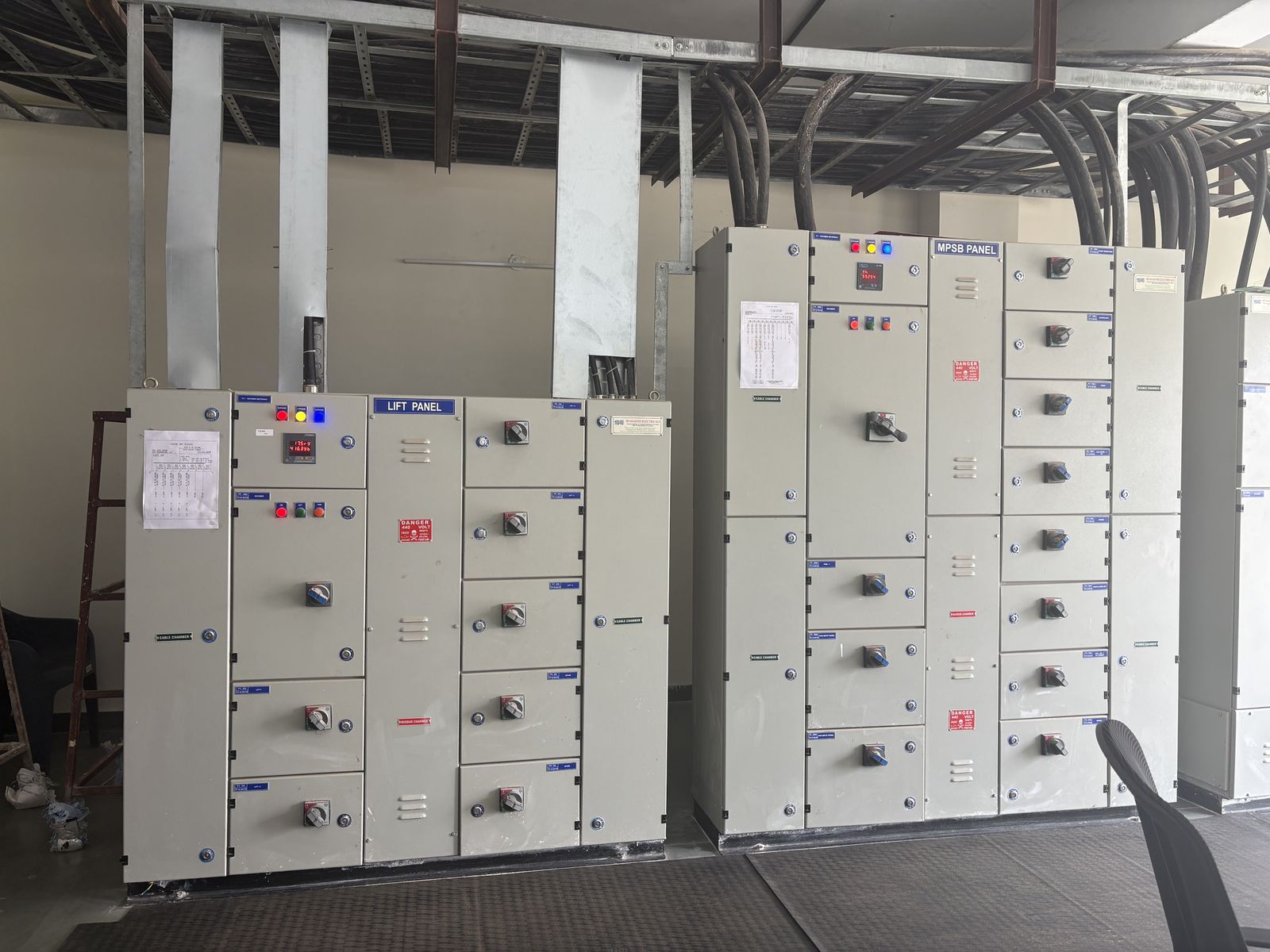
Capacitors supply reactive power locally, so the utility doesn't have to. Because a building's load changes through the day, the capacitors need to switch in and out in steps. That is exactly what an Automatic Power Factor Control (APFC) panel does: a controller measures the power factor continuously and switches capacitor banks to keep it near the target.
What a good APFC panel includes
- A reliable power factor controller with enough steps for your load variation.
- Capacitor banks rated for your network, with appropriate contactors and protection.
- Detuning reactors where harmonics are present — common in buildings with many LED drivers, UPS systems and VFDs.
- Adequate ventilation, since capacitors are sensitive to heat.
An APFC panel is one of the few pieces of electrical equipment that can show its value on the very next bill.
Keeping it working
Capacitors age. An APFC panel that was perfect at commissioning can slowly lose capacity until the penalty quietly reappears. Include the APFC panel in your preventive maintenance: check capacitor current, contactor condition and controller settings periodically.
How we can help
We supply and erect APFC panels along with LT and HT panels, and can review your existing bills and installation to tell you whether correction — or repair of an existing panel — will save you money. Send us a recent bill to get started.